Soft Sign and Hard Sign in Russian: What Ь and Ъ Do
The soft sign and hard sign are the two Russian letters with no sound of their own: the soft sign ь makes the consonant before it soft, and the hard sign ъ keeps a consonant separate from a following е ё ю я.
Ь (мягкий знак, myagkiy znak) softens the consonant before it, so брат (brother) and брать (to take) are different words. Ъ (твёрдый знак, tvyordyy znak) is rare today: it appears mainly after a prefix ending in a consonant, before е, ё, ю or я, as in съел (ate). Before 1918 it was also written at the end of many words.
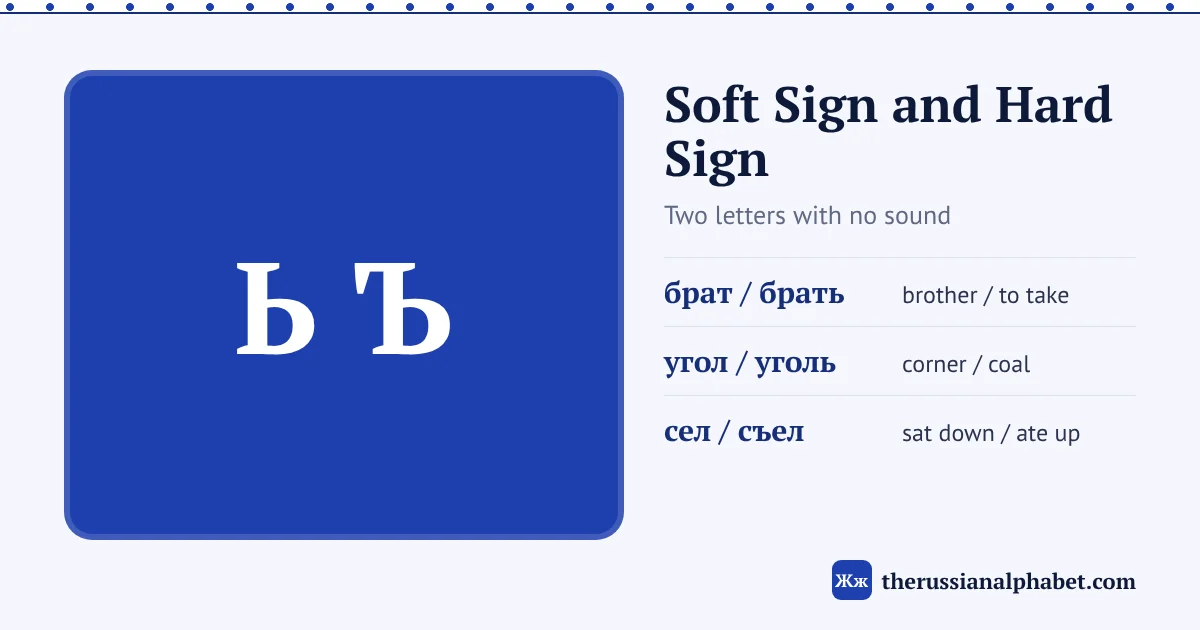
The two signs side by side
| Soft sign Ь ь | Hard sign Ъ ъ | |
|---|---|---|
| Russian name | мягкий знак (myagkiy znak) | твёрдый знак (tvyordyy znak) |
| Own sound | None | None |
| Main job | Softens the consonant before it; separates a consonant from a following vowel | Separates a hard consonant from a following е, ё, ю, я |
| How common | Very common | Rare |
| Can start a word? | No | No |
| Usual transliteration | ‘ or nothing | ” or nothing (ICAO passports: IE) |
| Example | sol’, salt | pod”yezd, building entrance |
Neither sign has a capital form in normal use, because no word begins with one; the capitals only appear in all-caps text. Both sit in the “signs” filter of the interactive Russian alphabet chart.
Soft sign, job 1: softening a consonant
A soft (palatalized) consonant is said with the middle of the tongue raised towards the hard palate, as if a faint y were starting at the same moment. Russian uses this difference to tell words apart, as a Harvard Russian course notes in its pronunciation appendix (PDF). These minimal pairs differ only by the soft sign. Play each pair and listen to the final consonant.
| Without ь | With ь |
|---|---|
| brat, brother | brat’, to take |
| mat, checkmate | mat’, mother |
| ugol, corner (stress: U-gol) | ugol’, coal (stress: U-gol’) |
| byl, was | byl’, true story |
| polka, shelf (stress: POL-ka) | pol’ka, polka; Polish woman (stress: POL’-ka) |
The soft sign is not the only way to soften a consonant. A following я е и ё ю does the same job, so the soft sign is needed mainly at the end of a word and before another consonant. The Russian vowels page explains that system.
Soft sign, job 2: separating a consonant from a vowel
Inside a word, ь before е ё и ю я tells you to pronounce a y between the consonant and the vowel. The consonant stays soft.
- (sem’ya, family): “sim-YA”, not “si-MYA”
- (stat’ya, article)
- пьёт (p’yot, drinks)
- бульон (bul’on, broth), one of a few borrowed words where ь stands before о
The soft sign in grammar
After ж ш ч щ the soft sign does not change the sound, because ж and ш are always hard and ч and щ always soft. There it is a spelling marker with grammatical meaning:
- Feminine nouns ending in a husher take ь: (noch’, night), дочь (doch’, daughter), мышь (mysh’, mouse), вещь (veshch’, thing). Masculine nouns do not: (myach, ball), нож (nozh, knife), врач (vrach, doctor).
- Verbs in the “you” (singular) form end in –шь: знаешь (znayesh’, you know).
- Infinitives end in –ть or –чь: знать (znat’, to know), мочь (moch’, to be able).
Many feminine nouns not ending in a husher also end in ь, such as соль (salt) and мать (mother), but so do some masculine nouns, such as уголь (coal). Outside the hushers, the ending alone does not tell you the gender.
The hard sign today
The hard sign has one main job: it sits between a prefix that ends in a consonant and a root that starts with е ё ю я. It shows that the consonant is not softened and that a y sound follows. Compare:
| Without ъ | With ъ |
|---|---|
| sel, sat down | s”yel, ate up |
More examples: (ob”yavleniye, announcement), въезд (v”yezd, entry for vehicles), отъезд (ot”yezd, departure). It also appears in some compounds beginning with двух-, трёх- or четырёх-, such as двухъярусный (dvukh”yarusnyy, two-tier), and in a few borrowed words like адъютант (ad”yutant, adjutant).
On the standard Russian keyboard, ъ is on the key to the right of х (the ] key on an English layout) and ь is on the M key. Try them on the online Russian keyboard.
The hard sign before 1918
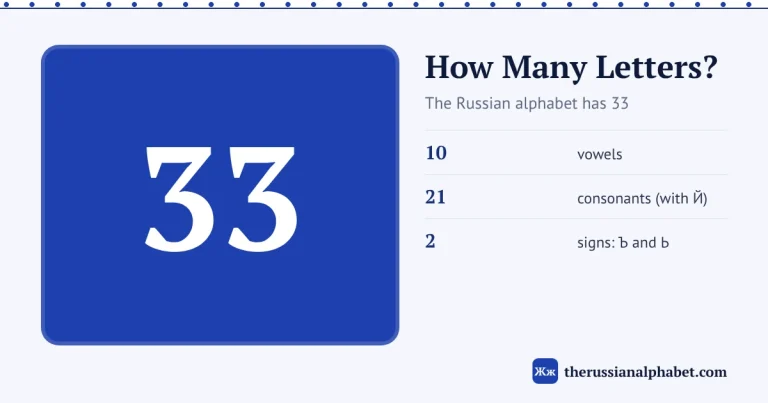
Before the spelling reform introduced by the Soviet government in 1918, ъ was written at the end of every word ending in a hard consonant: bread was хлѣбъ, not хлеб. It had long since stopped standing for any sound in that position. The reform dropped word-final ъ along with four letters, as The Moscow Times describes in its history of the reform. The letter itself survived for the separating job described above. You still see the old final ъ in brand names and shop signs that want an old-fashioned look. The full list of removed letters is on how many letters are in the Russian alphabet.
Transliteration treats the signs differently by system. Simple and BGN/PCGN styles use an apostrophe for ь and a double quote for ъ, or drop them. The ICAO standard used in Russian international passports writes ъ as IE and leaves ь out. Compare systems with the Russian transliteration tool.
FAQ
Does the soft sign make a sound?
No. It changes how the consonant before it is pronounced, making it soft, and before a vowel it signals a y sound. It has no sound of its own.
What is the difference between ь and ъ?
Ь softens the consonant before it and is very common. Ъ keeps a consonant hard and separate from a following е, ё, ю or я, and appears mostly after prefixes, as in съел.
Why do some old Russian words end in ъ?
Before the 1918 spelling reform, ъ was written at the end of every word ending in a hard consonant. The reform removed it from that position, but signs and brands sometimes keep it for a vintage look.
How do you transliterate the soft sign?
Usually with an apostrophe, as in sol’ for соль, or not at all. ISO 9 uses the prime symbol ʹ, and ICAO passport spellings leave it out.