Russian Alphabet to English: All 33 Letters With Their English Equivalents
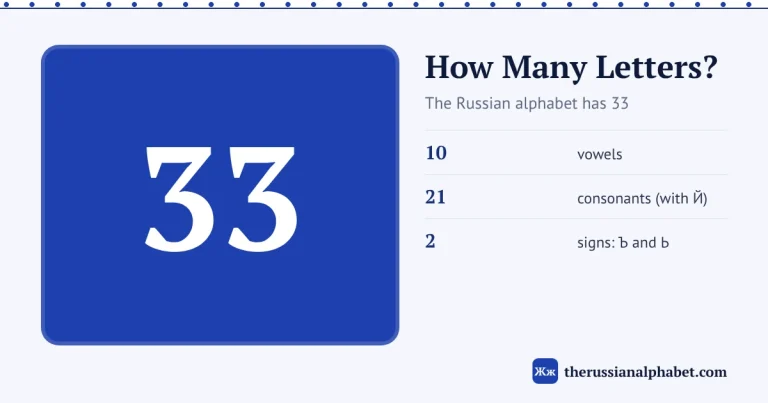
The Russian alphabet to English, letter by letter, maps 33 Cyrillic letters onto Latin letters or letter combinations: some match one English letter (М = m), some need two to four (Щ = shch), and two have no sound at all.
Five Russian letters look and sound like English ones (А К М О Т). Seven look familiar but stand for different sounds (В Е Н Р С У Х). The rest are new shapes, plus two signs, ъ and ь, that change how nearby letters are read. The table below gives the closest English letter for each one.
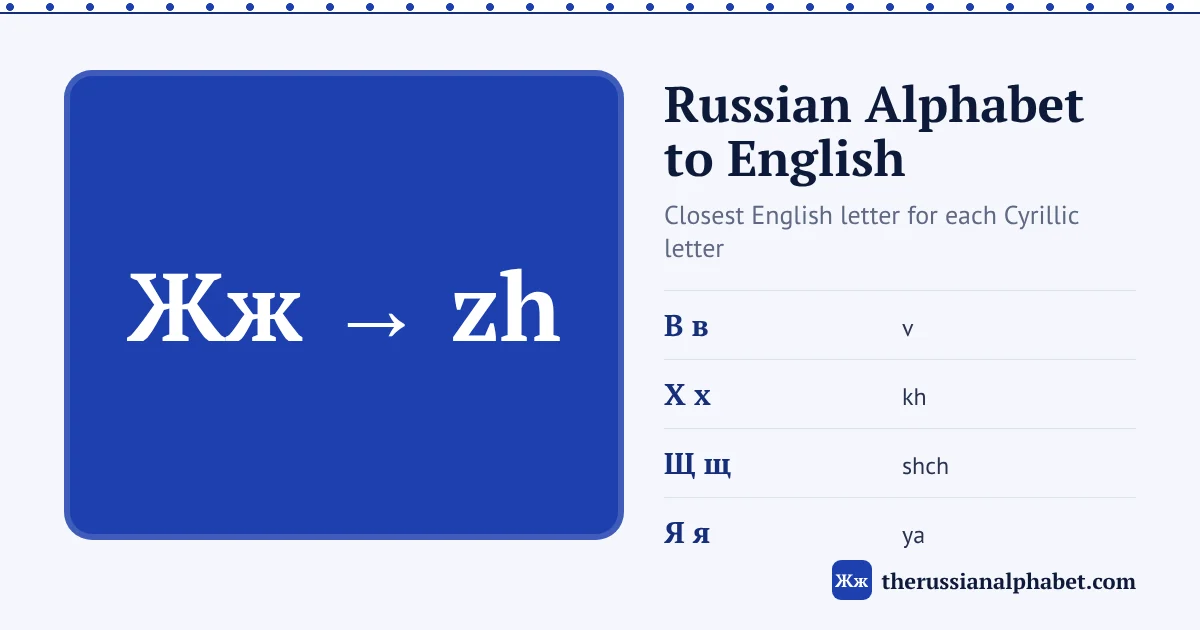
All 33 Russian letters with their English equivalents
The “English letter(s)” column uses the simple style most learners and road signs use. Tap any example word to hear it. Capitals in the stress note show the stressed syllable.
| Letter | English letter(s) | Sounds like | Example word |
|---|---|---|---|
| А а | a | a in father | arbuz, ar-BUZ, watermelon |
| Б б | b | b in bat | banan, ba-NAN, banana |
| В в | v | v in van | voda, vo-DA, water |
| Г г | g | g in go | gora, go-RA, mountain |
| Д д | d | d in dog | dom, house |
| Е е | ye / e | ye in yes | yeda, ye-DA, food |
| Ё ё | yo | yo in yonder | yozh, hedgehog |
| Ж ж | zh | s in measure | zhuk, beetle |
| З з | z | z in zoo | zima, zi-MA, winter |
| И и | i | ee in see | igra, ig-RA, game |
| Й й | y | y in boy | yogurt, YO-gurt, yogurt |
| К к | k | k in kite | kot, cat |
| Л л | l | l in lamp | lampa, LAM-pa, lamp |
| М м | m | m in man | mama, MA-ma, mom |
| Н н | n | n in no | nos, nose |
| О о | o | o in more | okno, ok-NO, window |
| П п | p | p in pen | park, park |
| Р р | r | rolled r, as in Spanish perro | ryba, RY-ba, fish |
| С с | s | s in sun | sok, juice |
| Т т | t | t in stop | tort, cake |
| У у | u | oo in boot | utro, U-tro, morning |
| Ф ф | f | f in fun | foto, FO-to, photo |
| Х х | kh | ch in Scottish loch | khleb, bread |
| Ц ц | ts | ts in cats | tsirk, circus |
| Ч ч | ch | ch in cheese | chay, tea |
| Ш ш | sh | sh in shop, said harder | shapka, SHAP-ka, hat |
| Щ щ | shch | a long, soft sh, as in fresh sheep | shchi, cabbage soup |
| Ъ ъ | ” (or nothing) | no sound: a separator before е, ё, ю, я | pod”yezd, pod-YEZD, building entrance |
| Ы ы | y | i in ill, said further back | syr, cheese |
| Ь ь | ‘ (or nothing) | no sound: softens the consonant before it | sol’, salt |
| Э э | e | e in bet | eto, E-to, this |
| Ю ю | yu | you | yubka, YUB-ka, skirt |
| Я я | ya | ya in yard | yabloko, YAB-lo-ko, apple |
Want to hear each letter on its own, or filter by type? The interactive Russian alphabet chart plays every letter and shows its handwritten form.
The four groups: familiar, false friends, new shapes and signs
Learning the table top to bottom works, but sorting the letters by how much they trick an English reader is faster. Most people can read simple Russian words after an hour or two with these groups.
1. Look and sound familiar: А К М О Т
These five behave the way you expect. А is the a of “father”, К is k, М is m, О is o (when stressed) and Т is t. With them alone you can already read (kot, cat) and (mama, mom).
2. False friends: В Е Н Р С У Х
These seven are the main source of misreadings because your eyes recognise them and your brain supplies the wrong sound.
- В в is v, not b.
- Е е is ye (as in “yes”) at the start of a word, or e after a consonant, which it also softens.
- Н н is n, not h.
- Р р is a rolled r, not p.
- С с is always s, never k.
- У у is the oo of “boot”, not y.
- Х х is kh, the throaty sound in Scottish “loch”, not x.
A word built only from false friends shows the trap well: looks like “pectopah” but reads restoran, restaurant.
3. New shapes
The remaining letters have no Latin look-alike, so there is nothing to unlearn. Several map neatly onto a single English letter: Б b, Г g, Д d, З z, И i (ee), Л l, П p, Ф f and Э e.
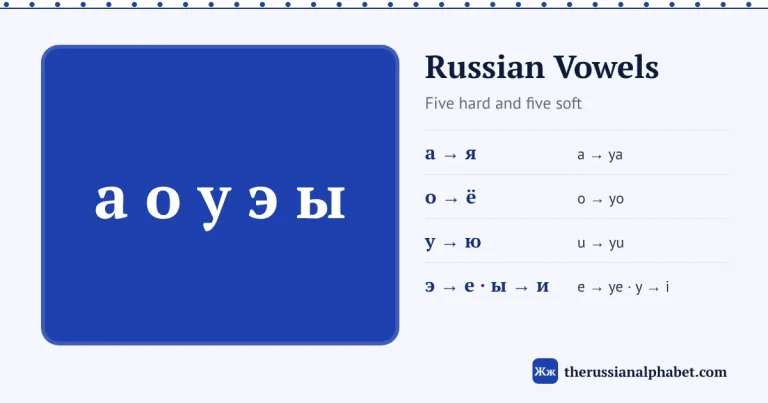
Others need a combination in English, because English writes these sounds with two or more letters: Ж zh, Ц ts, Ч ch, Ш sh, Щ shch, Ё yo, Ю yu and Я ya. Two more stand for sounds English handles differently: Й is the short y at the end of “boy”, and Ы is a vowel close to the i in “ill” but made further back in the mouth, as in (syr, cheese). The guide to Russian vowels covers ы, ё, ю and я in more detail.
4. Signs: Ъ and Ь
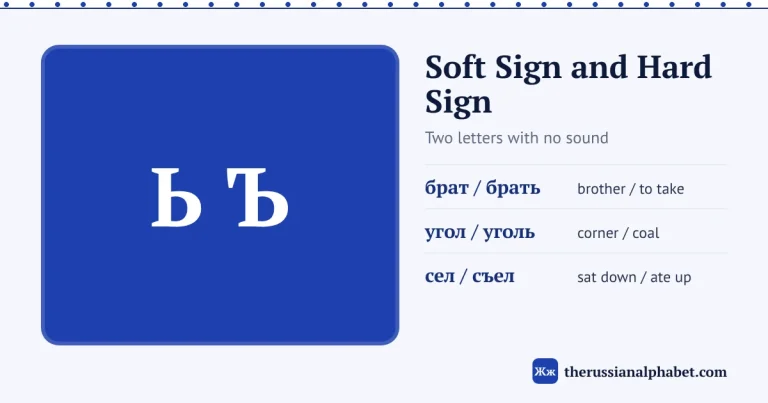
The hard sign ъ and the soft sign ь are letters with no sound of their own. The soft sign makes the consonant before it “soft” (said with the tongue raised towards the palate), as in (sol’, salt). The hard sign keeps a consonant apart from a following е, ё, ю or я, as in (pod”yezd, building entrance). In English spelling they are usually shown as an apostrophe and a double quote, or simply left out. See soft sign and hard sign for minimal pairs.
Why there is no single “English version” of each letter
Converting Russian letters into Latin ones is called transliteration, and several official systems exist. Each was built for a different job, so the same name can come out in several spellings. The main ones:
- Simple: the readable style used in textbooks, news and the table above.
- BGN/PCGN: the US and UK system for place names on maps.
- ICAO Doc 9303: the international standard for machine-readable travel documents, used in Russian international passports. It is capitals only and has no diacritics, so Ю becomes IU and Я becomes IA (see the ICAO Doc 9303 Part 3 transliteration table).
- ISO 9:1995: one Latin character for every Cyrillic letter, using diacritics (ž, š, û), so text can be converted back without loss.
| Russian | Simple | BGN/PCGN | ICAO (passport) | ISO 9 |
|---|---|---|---|---|
| Yuliya | Yuliya | IULIIA | Ûliâ | |
| Pyotr | Pëtr | PETR | Pëtr | |
| Khrushchyov | Khrushchëv | KHRUSHCHEV | Hruŝëv |
The letters that cause the most variation are Е Ё Й Х Ц Щ Ю Я Ы Ъ Ь. A side-by-side of the systems, compiled by the Institute of the Estonian Language, is in its Russian romanization table (PDF). Note also that Ё is often printed as Е without the dots, which is why the familiar English spelling is Khrushchev, not Khrushchyov.
To convert a name or a sentence in any of these four systems, paste it into the Russian transliteration tool. It also works the other way, from Latin letters back to Cyrillic.
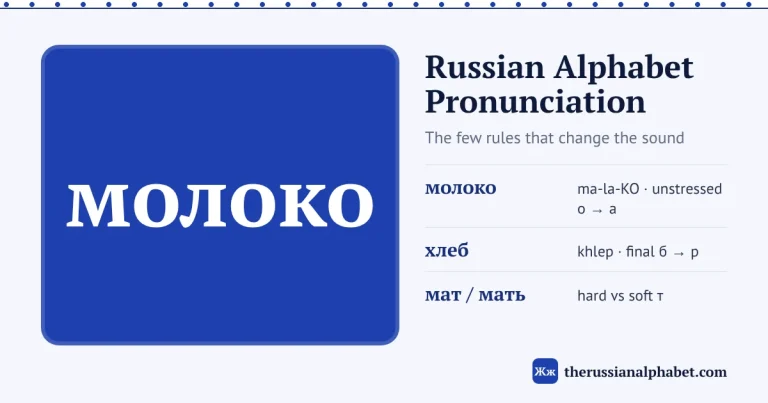
Transliteration shows spelling, not exact pronunciation. Russian vowels change when they are not stressed, so moloko (milk) is said closer to “ma-la-KO”. The Russian alphabet pronunciation guide explains these rules.
Reading practice: decode these words
Each word below uses only letters from the table. Read it letter by letter, check the transliteration, then play it.
- : taksi, taxi
- : metro, underground railway
- : sup, soup
- : borshch, beet soup
- : chay, tea
- : zhiraf, giraffe
When you can read these without the hints, test yourself with the Russian alphabet quiz.
FAQ
Does every Russian letter have an English equivalent?
No. About half map onto one English letter, several need two or more (zh, kh, ts, ch, sh, shch), and the hard and soft signs have no sound, so they are shown with punctuation marks or dropped.
Which Russian letters look like English letters but sound different?
В, Е, Н, Р, С, У and Х. They read as v, ye or e, n, r, s, oo and kh.
Why is my Russian name spelled differently in my passport?
Russian international passports follow the ICAO Doc 9303 standard, which uses only plain capital letters. It writes Ю as IU, Я as IA and Й as I, so Юлия becomes IULIIA rather than Yuliya.
How do you write Х in English?
Usually as kh, as in Khabarovsk. ISO 9 uses h instead. The sound is the one at the end of Scottish “loch”, not the x of “box”.