Russian Vowels: The 10 Vowel Letters, Hard and Soft Pairs, and Stress
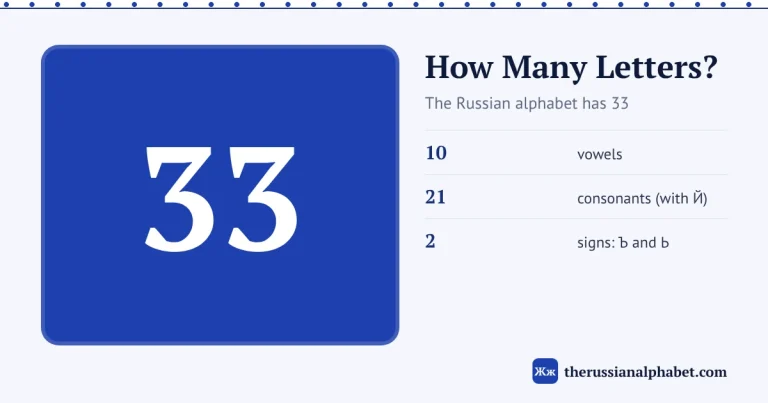
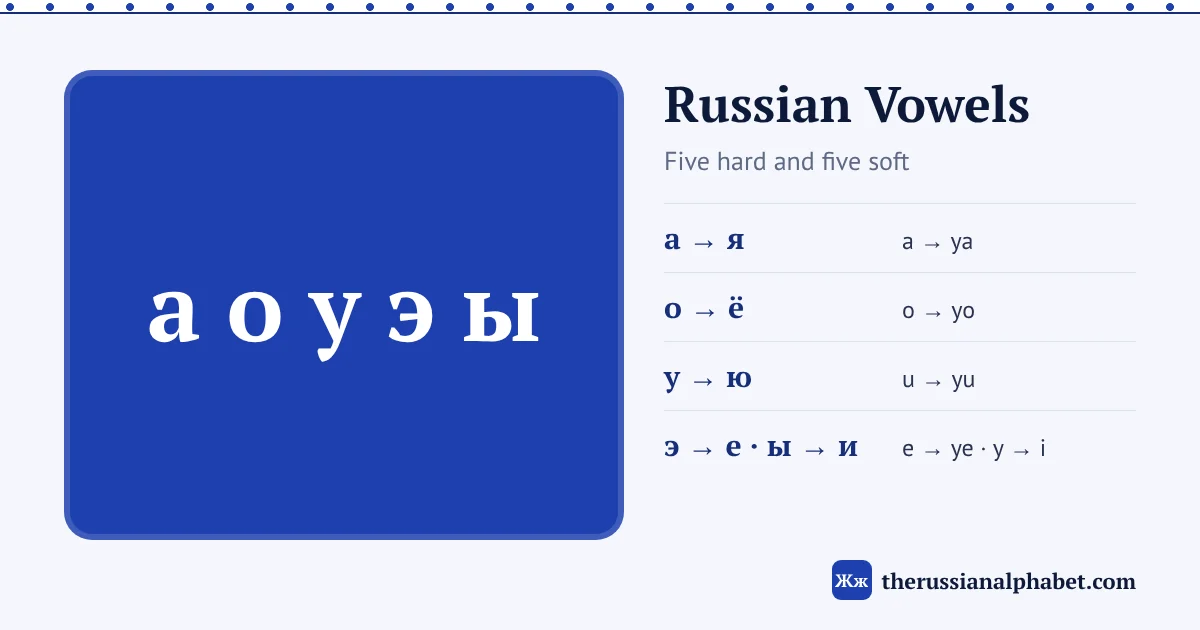
Russian vowels are written with 10 letters, а э ы о у and я е и ё ю, but they stand for only five basic vowel sounds: the second five are “soft” partners of the first five.
The hard-series vowels а э ы о у keep the consonant before them hard. Their soft-series partners я е и ё ю soften the consonant before them, and at the start of a word or after another vowel they add a y sound (я = ya). Stress matters too: only the stressed vowel keeps its full sound.
The five vowel pairs
Each row pairs a hard-series vowel with its soft-series partner. The vowel sound is nearly the same in both columns; what differs is the consonant before it. The last column shows a pair of real words that differ only in this choice. Play both to hear the softening.
| Hard series | Soft series | Sound | Hear the difference |
|---|---|---|---|
| а | я | a / ya | rad, glad / ryad, row |
| э | е | e / ye | eto, this / leto, summer (no exact pair; э is rare after consonants) |
| ы | и | y / i | byl, was / bil, beat |
| о | ё | o / yo | mol, pier / myol, swept |
| у | ю | u / yu | luk, onion / lyuk, hatch |
The idea that Russian has ten vowel letters for five vowel sounds, with the soft series signalling a soft consonant, is how standard textbooks present it; a Harvard Russian course sets it out in its pronunciation appendix (PDF). All ten are in the vowel filter of the interactive Russian alphabet chart.
The two jobs of я, е, ё and ю
These four are sometimes called iotated vowels, because in some positions they begin with a y sound (the Greek letter iota is the origin of the term). Where the letter sits decides which job it does.
After a consonant: soften it
After a consonant there is no separate y. The vowel tells you the consonant is soft (said with the tongue raised towards the palate). ряд is not “r-ya-d” with a full y; it is a soft r followed by a. The same holds for (myaso, meat; stress: MYA-so) and (leto, summer; stress: LE-to).
At the start of a word, after a vowel, or after ь or ъ: add a y
- Word start: (yabloko, apple; stress: YAB-lo-ko), (yozh, hedgehog), (yubka, skirt)
- After a vowel: (moya, my; stress: mo-YA)
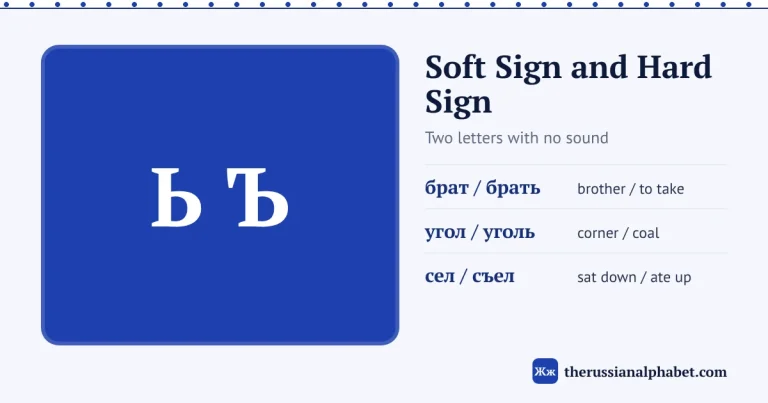
- After a sign: (sem’ya, family) and подъезд (pod”yezd, building entrance). Here the soft or hard sign keeps the consonant and the y apart. The page on the soft sign and hard sign explains when each is used.
И works a little differently: it softens a consonant before it, but it does not add a y at the start of a word. игра (igra, game) begins with a plain ee sound.
Ы and и: the pair English speakers mix up
И is the ee of “see”. Ы is made with the tongue pulled back and the lips relaxed, giving a sound close to the i of “ill” but further back. It follows hard consonants, so it almost never starts a word. If был and бил sound the same to you, practise saying и and sliding the tongue back without moving the lips.
Э and ё: the two special cases
Э is the e of “bet”. It appears mostly at the start of words, as in это (eto, this) and (ekho, echo), and in some borrowed words such as мэр (mer, mayor). In the middle of native words, the e sound is usually spelled with е.
Ё (yo) is always stressed, which makes it a handy stress marker. In everyday print it is usually written as е without the dots. The rules in force since 1956, summarised by the Russian Academy of Sciences’ Vinogradov Institute in an article on the letter ё (PDF, in Russian), make the dots required where a word would otherwise be confused with another (for example все, “everyone”, and всё, “everything”), and in dictionaries, children’s books and texts for learners of Russian.
Stress and reduction basics
Each word has one stressed syllable, and its position is not marked in ordinary text. The stressed vowel is said in full. Unstressed vowels weaken:
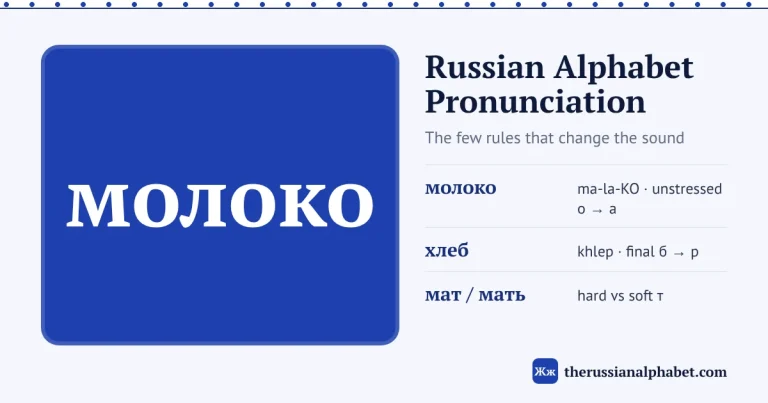
- unstressed о and а sound like a, or a short “uh” further from the stress: (moloko, milk) is “muh-la-KO”;
- unstressed е and я sound like a short i: (yazyk, language) is “yi-ZYK”;
- и ы у stay much the same.
The Russian alphabet pronunciation guide covers these rules with more examples.
Two spelling rules that involve vowels
- After г к х and after ж ч ш щ, write и, never ы. That is why the plural of книга (kniga, book) is книги (knigi), not книгы.
- After ж ч ш щ, write а and у, not я and ю: чай (chay, tea), щука (shchuka, pike).
Because ж and ш are always hard, the и written after them is pronounced like ы: жизнь (zhizn’, life) sounds like “zhyzn'”.
FAQ
How many vowels are in the Russian alphabet?
Ten vowel letters: а, э, ы, о, у and я, е, и, ё, ю. They represent five basic vowel sounds, with the second group also marking a soft consonant or a y sound.
Is й a vowel?
No. Й is a semivowel, the short y at the end of “boy”, and it is counted among the consonants. It cannot form a syllable on its own.
Why are some Russian vowels called soft?
Я, е, и, ё and ю make the consonant before them soft, meaning it is said with the tongue raised towards the palate. The vowel sound itself is close to that of its hard partner.
Is ё always stressed?
Yes. When ё appears in a word, its syllable carries the stress, which is one reason dictionaries and learner texts always print the dots.