Thank You in Russian: Спасибо, Its Variants and How to Reply
To say thank you in Russian, say (spasibo, spa-SI-bo). It works with anyone, in any setting, from a shop counter to a business meeting, and the usual reply is (pozhaluysta, po-ZHA-luy-sta), “you’re welcome”.
Thank you = Спасибо (spa-SI-bo). Thank you very much = Большое спасибо (bol’-SHO-ye spa-SI-bo). You’re welcome = Пожалуйста or, more casually, Не за что (NYE za shto), “it’s nothing”.
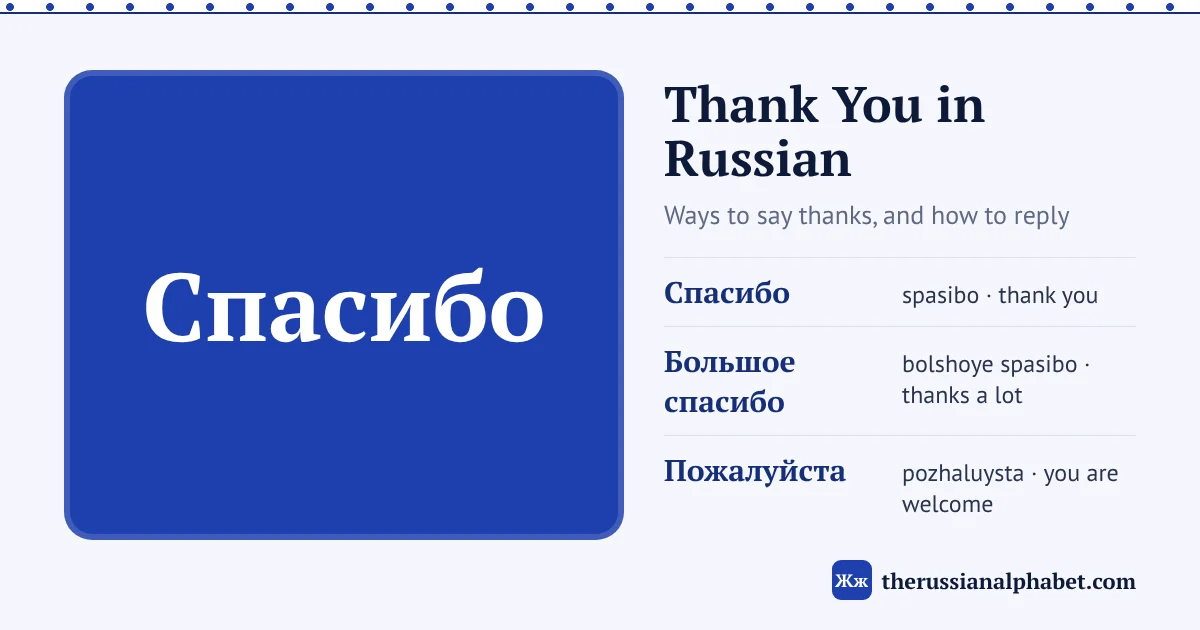
Ways to say thank you in Russian
Спасибо is neutral. It is neither formal nor casual, so you never need to choose a different word just because you are talking to a stranger. To make it stronger, add an adjective.
- (bol’shoye spasibo, bol’-SHO-ye spa-SI-bo): “thank you very much”, literally “big thanks”.
- (spasibo bol’shoye): the same words in the other order. Both are correct and both are common; this order is especially frequent in quick, spoken thanks.
- (ogromnoye spasibo, og-ROM-no-ye spa-SI-bo): “huge thanks”, for a real favour.
- (blagodaryu, bla-go-da-RYU): “I thank (you)”. A verb, not a noun, and noticeably more formal or bookish than спасибо.
- / (spasibo vam / spasibo tebe, te-BYE): “thank you” with the “you” spelled out, polite or informal. Adding the pronoun makes the thanks more personal.
In fast, relaxed speech спасибо is sometimes clipped to пасибо or пасиб, as Russian Life notes. That is fine to recognise but best not to copy until you are comfortable with the register.
The stress guides on this page follow the spelling, with the stressed syllable in capitals. In real speech an unstressed о sounds close to “a”, so большое comes out nearer bal-SHO-ye. One more quirk: in что the ч is said as “sh”, hence NYE za shto. See Russian vowels for the full rule.
Thanking someone for something: Спасибо за…
To say what you are thankful for, add за (za, “for”) and the thing. These short set phrases cover most situations:
| Russian | Say it | Meaning |
|---|---|---|
| spasibo za pomoshch’, za PO-moshch | Thanks for the help | |
| spasibo za vsyo, za VSYO | Thanks for everything | |
| Спасибо за подарок | spasibo za podarok, za po-DA-rok | Thanks for the gift |
| Спасибо за ужин | spasibo za uzhin, za U-zhin | Thanks for dinner |
Notice всё with two dots. Without them, все (vse) means “everyone”, and Russian texts often leave the dots off ё. Context usually makes the meaning clear.
Which one to use: a formality table
| Phrase | Register | Typical use |
|---|---|---|
| Спасибо | Neutral | Everywhere, with everyone |
| Большое спасибо / Спасибо большое | Neutral, warmer | A favour, good service, help with directions |
| Огромное спасибо | Neutral, emphatic | Something that really mattered |
| Спасибо вам | Polite | Thanking a person you address as вы |
| Спасибо тебе | Informal | Friends and family |
| Благодарю | Formal, bookish | Speeches, letters, customer service; slightly stiff in casual talk |
| Пасибо, пасиб | Very casual | Close friends, quick text messages |
The choice between вам and тебе follows the same вы/ты split as greetings, explained on the hello in Russian page.
How to reply when someone says спасибо
- (pozhaluysta, po-ZHA-luy-sta): “you’re welcome”. The default reply, polite with anyone. In everyday speech it is often shortened to something like pa-ZHAL-sta. The same word also means “please”.
- (ne za chto, NYE za shto): “it’s nothing”, literally “not for anything”. Friendly and conversational. Written as three separate words, with the stress on не.
- (ne stoit, ne STO-it): “don’t mention it”, short for не стоит благодарности, “it’s not worth thanks”. Polite, a little more formal.
- (na zdorov’ye, na zdo-RO-v’ye): “to your health”. The natural reply when someone thanks you for food or drink.
A short article in Lenta.ru (in Russian) quotes Efremova’s dictionary on the spelling of не за что and adds a useful nuance from a language teacher: because the phrase suggests your help “was not worth thanks”, tone matters. Said warmly it is friendly; said flatly it can sound dismissive. When in doubt, пожалуйста is the safe choice.
Where спасибо comes from
Спасибо grew out of the phrase спаси Бог (spasi Bog), “may God save (you)”. Over time the two words fused and the final consonant of Бог dropped away, leaving спасибо. This origin is given in Max Vasmer’s Etymological Dictionary of the Russian Language, the standard reference, and is summarised in English by Russian Life, which calls the word “a conflation of спаси Бог“.
The formal благодарю has a similar logic. Take the verb благодарить apart and you get дарить благо, “to give a blessing” or “to give good”. Both everyday ways of thanking someone therefore began as wishes for the other person, not as a statement about yourself.
Reading спасибо letter by letter
С-п-а-с-и-б-о: s, p, a, s, i, b, o. Two of the seven letters are traps for English readers. С looks like C but is always s, and п is p, not n. The б is a new shape for b. Check any of them on the interactive Russian alphabet chart, or paste a phrase into the Russian transliteration tool to see it in Latin letters.
Related pages
- ПпHello in RussianЗдравствуйте, привет and greetings for every time of day.
- ЮюI love you in RussianЯ тебя люблю, word order and related phrases.
- ОоRussian pronunciationStress, vowel reduction and soft consonants explained.
FAQ
How do you pronounce спасибо?
Say spa-SI-bo, with the stress on the middle syllable. The final о is unstressed, so in natural speech it sounds closer to a short “a”: spa-SI-ba.
How do you say thank you very much in Russian?
Say Большое спасибо or Спасибо большое (bol’-SHO-ye spa-SI-bo). For extra emphasis, Огромное спасибо means “huge thanks”.
What is the difference between пожалуйста and не за что?
Both answer спасибо. Пожалуйста (“you’re welcome”) is the neutral, polite default. Не за что (“it’s nothing”) is more conversational and depends more on a friendly tone.
Is благодарю more polite than спасибо?
It is more formal, not more sincere. Благодарю fits speeches, letters and official settings. In everyday conversation спасибо is normal even with strangers and superiors.
What does спасибо literally mean?
It comes from спаси Бог, “may God save (you)”. The two words merged into one over time, and today most speakers use спасибо without any religious sense.