Russian Alphabet Pronunciation: Letter Sounds and the Rules That Change Them
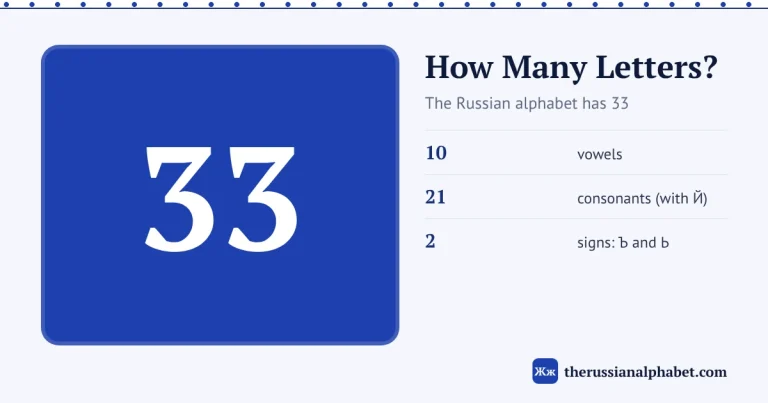
Russian alphabet pronunciation is mostly regular: once you know the sound of each of the 33 letters, a handful of rules (stress, vowel reduction, soft consonants and devoicing) explain almost every difference between how a word is spelled and how it is said.
Learn the letter sounds first, then four rules: unstressed о sounds like a, unstressed е and я sound like a short i, a voiced consonant at the end of a word turns voiceless (хлеб is said “khlep”), and many consonants come in hard and soft pairs. Russian р is rolled, and ы has no English equivalent.
Letter sounds, sorted by difficulty
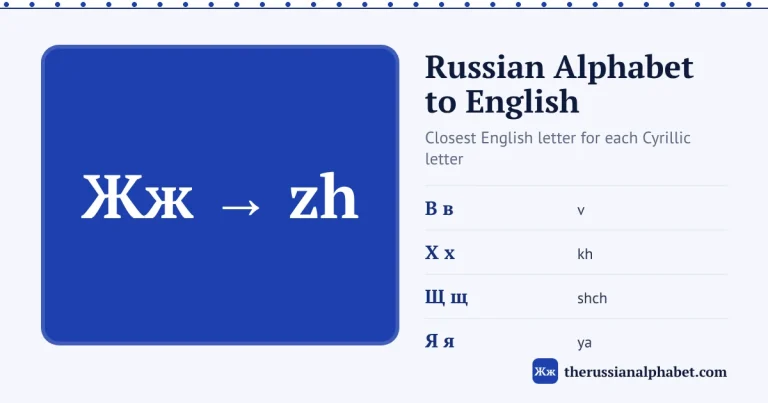
For a letter-by-letter table with English equivalents, see Russian alphabet to English, and use the interactive Russian alphabet chart to hear each letter. Here the letters are grouped by how much work they take for an English speaker.
- Close to English: б в г д з к л м н п с т ф. One difference matters: Russian п т к are said without the small puff of air that English adds to p, t and k at the start of a word. Hold a hand in front of your mouth; for кот you should feel very little air.
- Familiar sounds, new spelling: ж (s in “measure”), ц (ts in “cats”), ч (ch in “cheese”), ш (sh), й (y in “boy”), х (ch in Scottish “loch”).
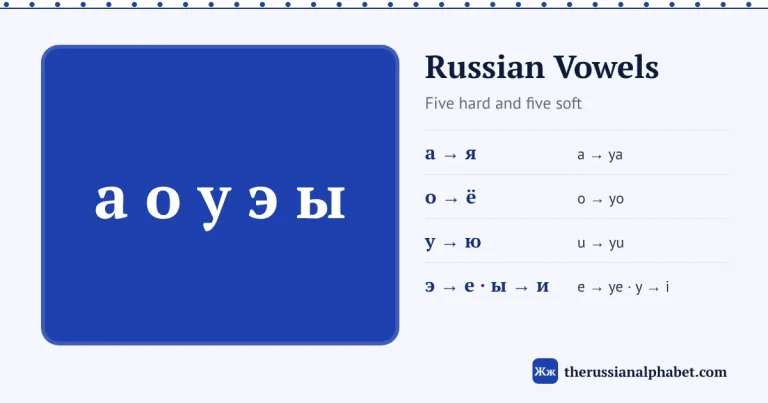
- Vowels: а э ы о у and their soft partners я е и ё ю. Stressed vowels are clear and short, without the glide English puts in “go” or “day”.
- Genuinely new: ы, the rolled р, щ, and the soft consonants marked by ь or a following soft vowel.
Rule 1: stress decides how vowels sound
Every Russian word of more than one syllable has one stressed syllable. Stress can fall on any syllable, it can move when a word changes form, and ordinary texts do not mark it. Learner dictionaries and textbooks show it with an accent mark. Stress can even separate two words spelled alike: замок is zamok (stress: ZA-mok) “castle”, or zamok (stress: za-MOK) “lock”.
Only the stressed vowel keeps its full sound. Unstressed vowels are weakened, which is called vowel reduction. In standard Russian:
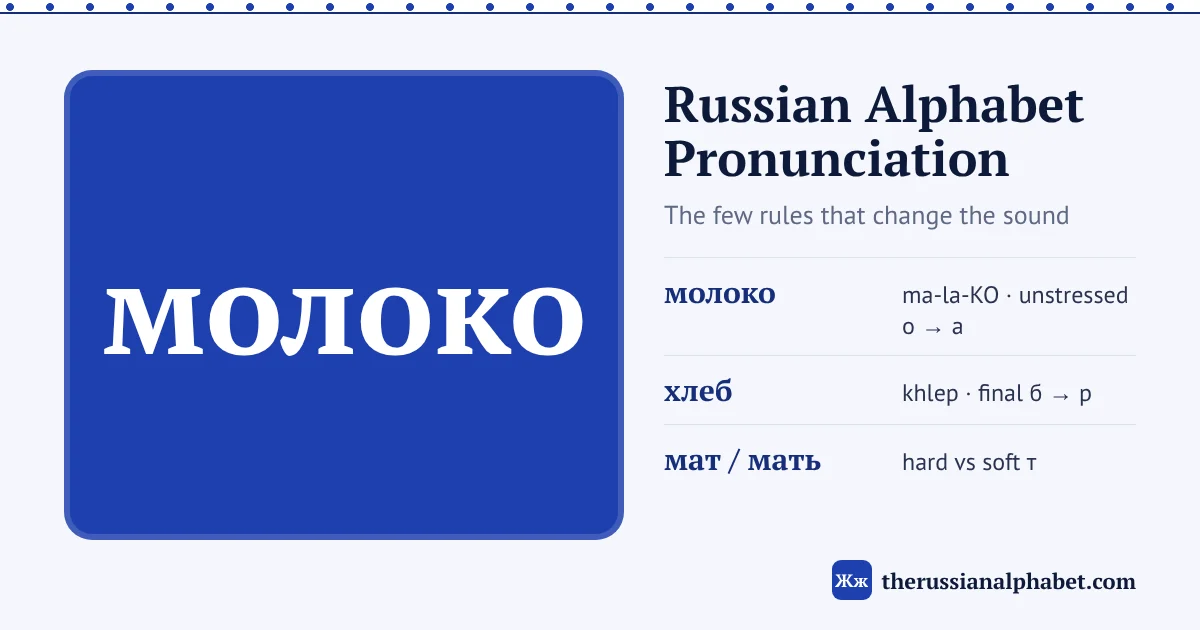
- Unstressed о sounds like a (in the syllable just before the stress), and like a short, neutral “uh” further away. This is called akanye. (moloko, milk) is said roughly “muh-la-KO”; (khorosho, good) is “khuh-ra-SHO”; окно (okno, window) is “ak-NO”.
- Unstressed е and я sound like a short i after soft consonants. This is called ikanye. (yazyk, language) is said “yi-ZYK”, and телефон (telefon, telephone) is “ti-li-FON”.
- и, ы and у do not change much when unstressed.
The rules and their finer degrees are set out in vowel reduction in Russian, which draws on Alan Timberlake’s A Reference Grammar of Russian. More on each vowel is in the Russian vowels guide.
Rule 2: hard and soft consonants
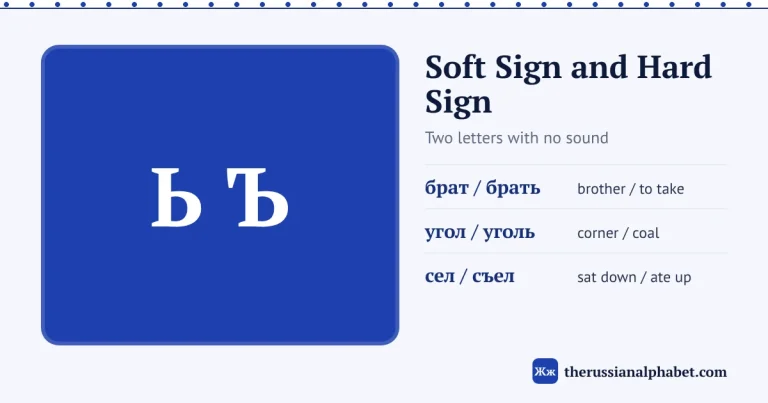
Most Russian consonants come in two versions. A hard consonant is said with the tongue in its normal position. A soft (palatalized) consonant is said with the middle of the tongue raised towards the hard palate, as if starting a y at the same time. The difference changes meaning, as a Harvard Russian course’s pronunciation appendix (PDF) illustrates with брат and брать.
Spelling tells you which version to use. A consonant is soft before ь or before one of the soft-series vowels я е и ё ю. Otherwise it is hard.
| Hard | Soft | What changes |
|---|---|---|
| brat, brother | brat’, to take | final т hard vs soft |
| luk, onion | lyuk, hatch | л hard vs soft |
| byl, was | bil, beat | б hard (with ы) vs soft (with и) |
A few consonants have only one version. ж ш ц are always hard, so жизнь (zhizn’, life) is said with an ы-like vowel. ч щ й are always soft. The full story of the two signs is on soft sign and hard sign.
Rule 3: final devoicing and voicing assimilation
Voiced consonants (made with the vocal cords vibrating) have voiceless partners: б/п, в/ф, г/к, д/т, ж/ш, з/с. Two rules swap them in speech while the spelling stays the same.
Final devoicing
At the end of a word, a voiced consonant is said as its voiceless partner:
- (khleb, bread) is said “khlep”
- (gorod, city; stress: GO-rod) is said “GO-rat”
- (drug, friend) is said “druk”
Voicing assimilation
When consonants meet, the last one in the cluster sets the voicing for the group. In (vodka) the д is said as т before the voiceless к: “VOT-ka”. In (futbol, football) the т becomes д before б: “fud-BOL”. Short prepositions join the next word, so в кино (v kino, to the cinema) begins “fki-“.
The four sounds that need practice: ы, р, ш and щ
Ы
Say the ee of “see”, then pull your tongue back without moving your lips. The result is close to the i in “ill” but made further back. Try ты (ty, you) and (syr, cheese).
The rolled Р
Russian р is a trill: the tip of the tongue taps or vibrates behind the upper teeth, as in Spanish “perro”. A single quick tap is acceptable in fast speech. The English r, with the tongue curled back, is the giveaway of a foreign accent. Practise with (ryba, fish; stress: RY-ba).
Ш versus Щ
Ш is a hard sh, with the tongue pulled back and slightly hollowed, as in (shapka, hat). Щ is a long, soft sh with the tongue raised high, close to the sound across “fresh sheep”. Standard Russian today says it as one long sound, not “sh” plus “ch”, even though transliteration writes shch. Compare (shchi, cabbage soup) and ещё (yeshchyo, more; stress: ye-SHCHYO).
Common mistakes English speakers make
1. Saying every о as o. Only stressed о is a full o; молоко has one. 2. Reading В Н Р С as b, h, p, k. They are v, n, r and s. 3. Ignoring the soft sign. брат and брать are different words. 4. Treating ы as и. был and бил differ only in this vowel. 5. Voicing final consonants. хлеб ends in a p sound. 6. Reading г in –ого and –его as g. In these endings it is said as v: его (yego, him) is “yi-VO”, and сегодня (segodnya, today) is “si-VOD-nya”.
Two very common words also break the spelling rules: (chto, what) is said “shto”, and the first в in (zdravstvuyte, hello) is silent. See hello in Russian for more greetings.
FAQ
Is Russian pronunciation hard for English speakers?
The letters are quick to learn, and spelling follows pronunciation more closely than in English. The harder parts are unmarked stress, soft consonants, the rolled р and the vowel ы.
Why does Russian о sometimes sound like a?
Because of vowel reduction. Only the stressed о is a full o. Unstressed о is said as a or as a short neutral vowel, so молоко sounds like “muh-la-KO”.
How do I know where the stress falls in a Russian word?
Normal Russian text does not mark it, so stress has to be learned with each word. Learner dictionaries and textbooks show it with an accent mark, and the letter ё is always stressed.
What is the difference between ш and щ?
Ш is a hard sh with the tongue pulled back. Щ is a longer, soft sh with the tongue raised towards the palate, close to the sound across “fresh sheep”.
- ЫыRussian vowelsThe 10 vowel letters, hard and soft pairs, and stress.
- ЬьSoft sign and hard signWhat ь and ъ do, with minimal pairs to listen to.
- ЩщRussian alphabet quizTest yourself on letters and sounds in 10-question rounds.