I Love You in Russian: Я тебя люблю, Word Order and Related Phrases
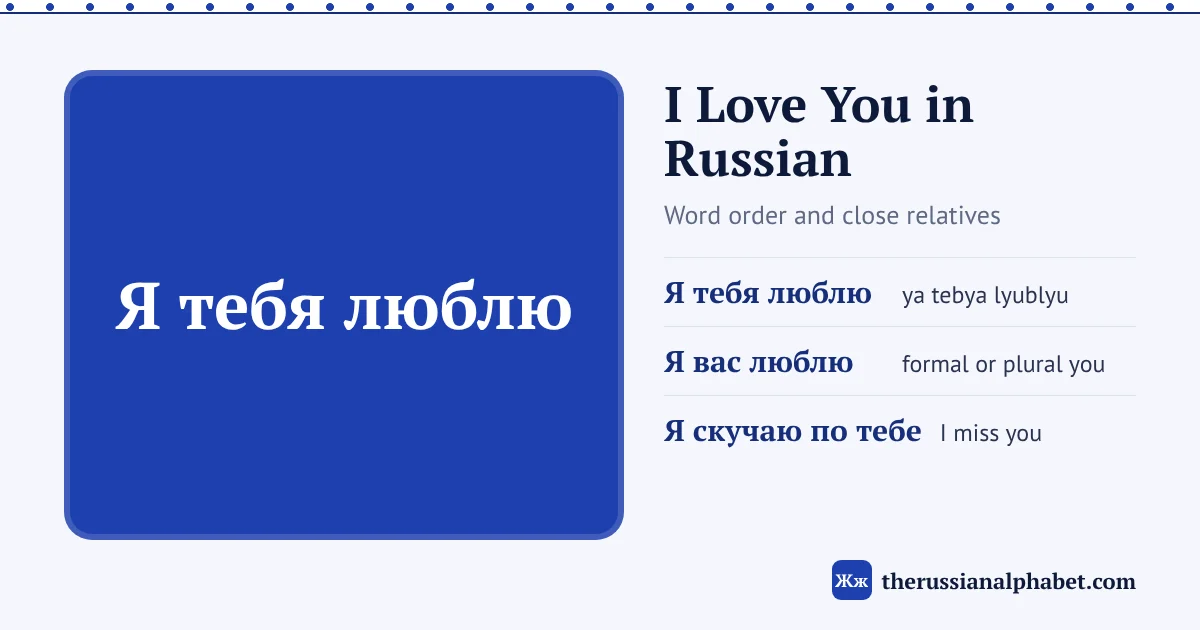
The standard way to say I love you in Russian is (ya tebya lyublyu, ya te-BYA lyub-LYU). Word for word it reads “I you love”: this most common version puts тебя (“you”) before the verb, though the other order is also correct.
Я тебя люблю (ya te-BYA lyub-LYU) is “I love you” to one person you are close to. Я вас люблю uses the polite or plural “you”. The usual reply is Я тоже тебя люблю, “I love you too”.
Word order and how emphasis shifts
Russian marks who does what with word endings, not word order, so the three words of “I love you” can be arranged in several ways without changing the basic meaning. What changes is the weight. Russian tends to move from known information to new or important information, putting the focus toward the end of the sentence, as the Polyglottist Language Academy explains in its overview of Russian word order.
| Version | Say it | Feel |
|---|---|---|
| ya te-BYA lyub-LYU | The neutral, standard form. The verb comes last, so the weight is on “love”. | |
| ya lyub-LYU te-BYA | Also common and fully correct. With “you” at the end, it leans slightly more on the person. | |
| lyub-LYU te-BYA | “Love you”. Dropping я makes it softer and more intimate; common at the end of a call or message. | |
| te-BYA ya lyub-LYU | Emphatic and contrastive: “It is you I love.” Used when there is a point to make, not as an everyday line. |
Spoken intonation matters as much as order. Stressing тебя with your voice in the neutral sentence has the same “you, specifically” effect as moving it.
Я вас люблю: the formal and plural version
(ya vas lyub-LYU) swaps тебя for вас, the object form of вы. Russian uses вы both for one person you address politely and for any group (see hello in Russian for the ты/вы split). So the phrase has two uses:
- Plural: “I love you all”, for example a performer to an audience or a parent to several children.
- Formal singular: a declaration to someone you still call вы. This sounds distinctly old-world today; couples who say “I love you” are almost always on ты terms. It is famous from Pushkin’s 1829 poem that begins Я вас любил, “I loved you”.
Note that the phrase does not change with the speaker’s or listener’s gender. A man and a woman both say Я тебя люблю. Gender shows up only in the past tense (любил said by a man, любила by a woman) and in adjectives such as любимый below.
Related phrases
| Russian | Say it | Meaning |
|---|---|---|
| ya tozhe tebya lyublyu, ya TO-zhe te-BYA lyub-LYU | I love you too | |
| i ya te-BYA | Me too, I love you too (literally “and I you”); short and warm | |
| ty mne nravish’sya, ty MNYE NRA-vish-sya | I like you (romantically or as a person); a step before love | |
| ya skuchayu po tebe, ya sku-CHA-yu po te-BYE | I miss you | |
| moy lyubimyy, MOY lyu-BI-myy | My love, my beloved (to a man) | |
| moya lyubimaya, mo-YA lyu-BI-ma-ya | My love, my beloved (to a woman) | |
| lyubov’, lyu-BOV’ | Love (the noun) |
Ты мне нравишься is built differently from English. Literally it says “you are pleasing to me”: the person you like is the subject, and “me” (мне) is the one who experiences it. The same pattern gives Мне нравится, “I like it”. Любимый also means “favourite” in everyday use, as in a favourite film, so context decides whether it is romantic.
Reading Я тебя люблю letter by letter
The phrase has ten letters but only six different shapes. Hear each one on the interactive Russian alphabet chart.
| Word | Letters | How it reads |
|---|---|---|
| я | я | One letter, two sounds: “ya”. On its own it is the word “I”. |
| тебя | т + е + б + я | t, then е (softens the t), b, then я (softens the b): te-BYA. The б is a new shape for b; do not confuse it with 6. |
| люблю | л + ю + б + л + ю | soft l, u, b, soft l, u: lyub-LYU. Each ю softens the л before it. |
In natural speech the unstressed е in тебя is weakened, so it sounds closer to “ti-BYA”. The Russian vowels guide covers this reduction. If you want to type the phrase, the online Russian keyboard lets you spell it phonetically on a Latin keyboard, and the Russian cursive converter shows how it looks handwritten, for a card or note.
How to pronounce ю
Ю is one of the Russian vowels that carry a built-in “y”. How it sounds depends on what comes before it:
- At the start of a word or after a vowel it is “yu”, like English “you”: (yubka, YUB-ka, skirt).
- After a consonant no separate “y” is heard. Instead the consonant becomes soft (said with the middle of the tongue raised toward the palate) and the vowel is “u”. That is what happens twice in .
The Wikipedia article on the letter Yu summarises the rule: after a consonant “no distinct [j] sound is pronounced, but the consonant is softened”. So люблю is not “lee-yoob-lee-yoo”. It is two quick syllables with a soft, light l, close to the l in “million”. The pairing of hard and soft consonants is explained further on the Russian alphabet pronunciation page.
Related pages
- ЮюRussian vowelsAll 10 vowels, and how я, ю, е, ё soften consonants.
- СсThank you in RussianСпасибо, its variants, and how to reply.
- ЛлRussian cursiveTurn any phrase into Russian handwriting.
FAQ
How do you reply to я тебя люблю?
Say Я тоже тебя люблю (ya TO-zhe te-BYA lyub-LYU), “I love you too”, or the shorter И я тебя, “and I you”.
Is it я тебя люблю or я люблю тебя?
Both are correct. Я тебя люблю is the most common, neutral form. Я люблю тебя puts slightly more weight on “you”. Люблю тебя, without я, is softer and more intimate.
Does I love you change for a man or a woman in Russian?
No. Я тебя люблю is the same whoever says it and whoever hears it. Gender appears only in the past tense (любил or любила) and in words like любимый (to a man) and любимая (to a woman).
How do you say I like you in Russian?
Say Ты мне нравишься (ty MNYE NRA-vish-sya). Literally it means “you are pleasing to me”, and it is the usual way to express interest before saying люблю.
How do you pronounce люблю?
Say lyub-LYU, with the stress on the second syllable. Each ю softens the л before it, so you hear a soft l followed by “u”, not a separate “y” sound.