Hello in Russian: Здравствуйте, Привет and Greetings for Every Situation
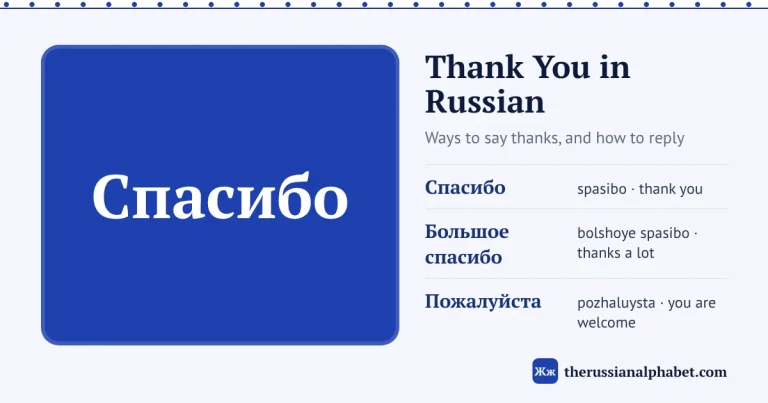
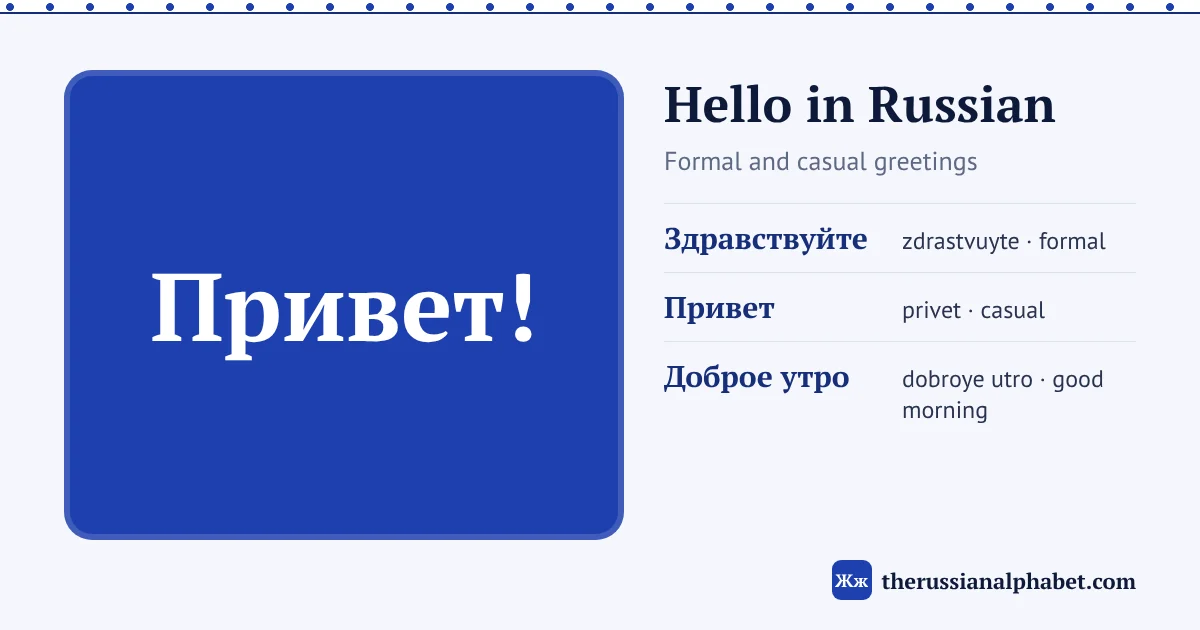
The most common way to say hello in Russian is (zdravstvuyte, ZDRAST-vuy-tye), the polite greeting for strangers, older people and any group. With friends and family you say (privet, pri-VYET), which means “hi”.
Formal: Здравствуйте (ZDRAST-vuy-tye), with the stress on the first syllable and the first в left silent. Informal: Привет (pri-VYET). If you are not sure which to use, choose Здравствуйте: nobody minds being greeted too politely.
Formal or informal: ты and вы
Russian has two words for “you”. Ты (ty) is for one person you know well: family, close friends, children, people your own age in casual settings. Вы (vy) is for one person you should be polite to, and for any group of two or more, whoever they are.
Greetings follow the same split. Здравствуйте ends in -те, the ending that goes with вы. Drop it and you get (zdravstvuy, ZDRAST-vuy), the informal form for one person you call ты. Привет is informal only. The University of Kansas course Между нами gives learners a simple rule: start with вы when you speak to an adult, and always use вы for more than one person.
- Shop assistant, teacher, colleague you just met, a whole class: Здравствуйте.
- A friend, a sibling, a child: Привет or Здравствуй.
- Two friends together: Привет still works, but the formal-looking Здравствуйте is also correct, because вы covers any group.
Russian greetings by situation and time of day
Beyond the two basic words, Russian has greetings tied to the time of day and a handful of casual ones. Tap a word to hear it.
| Russian | Say it | Meaning | When to use it |
|---|---|---|---|
| dobroye utro, DO-bro-ye U-tro | Good morning | Morning, with anyone | |
| dobryy den’, DOB-ryy DYEN’ | Good afternoon, good day | Daytime; polite and neutral, common in shops, offices and emails | |
| dobryy vecher, DOB-ryy VYE-cher | Good evening | Evening, with anyone | |
| privet, pri-VYET | Hi | Friends, family, peers | |
| privetik, pri-VYE-tik | Hiya (a playful diminutive of привет) | Close friends, often in messages | |
| Здорово | zdorovo, zdo-RO-vo | Hey, how’s it going | Very casual, between friends. Stress the middle syllable: with the stress on the first (ZDO-ro-vo) the same spelling means “great!” |
| salyut, sa-LYUT | Hi (literally “salute”) | Casual, between friends | |
| allo, al-LO | Hello? (on the phone) | Only when answering or checking a phone line | |
| rad tebya videt’, RAD te-BYA VI-det’ | Glad to see you | A man says рад, a woman says рада (RA-da). Swap тебя for вас (vas) to make it polite. |
The three “good …” greetings are safe in any setting, formal or not. Добрый день in particular is a handy neutral choice when Здравствуйте feels like a mouthful.
The silent в in здравствуйте
Здравствуйте is spelled with two letters в (v), but only the second one is pronounced. The cluster -вств- is simplified in speech to -ств-, so the word sounds like “zdrastvuytye”. Wiktionary shows it with the phonetic respelling здра́ствуйте and the transcription [ˈzdrastvʊjtʲe].
The spelling keeps the first в because the word is built on the root здрав-, “healthy”. Grammatically, здравствуйте is the polite imperative of the verb здравствовать, “to be healthy, to thrive”, so the greeting literally wishes the other person good health. In fast, casual speech it often shrinks further, to здрасьте (zdras’tye).
Silent letters like this are rare in Russian. Most words are read exactly as written once you know the pronunciation rules for each letter, so do not treat здравствуйте as typical.
How to answer “how are you?” in Russian
In English, “how are you?” is often just part of hello. In Russian it is a real question, asked after the greeting, and people expect an actual answer. The Kansas course stresses this point: Как дела? is not a greeting.
- (kak dela, kak de-LA): “How are things?” Informal. The polite version adds у вас: Как у вас дела? (kak u vas de-LA).
- (kak pozhivayete, kak po-zhi-VA-ye-te): “How are you getting on?” Polite and a little old-fashioned.
Common answers, from best to worst:
| Answer | Say it | Meaning |
|---|---|---|
| otlichno, ot-LICH-no | Great | |
| khorosho, kho-ro-SHO | Good, fine | |
| normal’no, nor-MAL’-no | OK, all right | |
| neplokho, ne-PLO-kho | Not bad | |
| Так себе | tak sebe, tak se-BYE | So-so |
Then hand the question back: А у вас? (a u vas, “And you?”, polite) or А у тебя? (a u te-BYA, informal). Starting the answer with Спасибо (spasibo, “thanks”) sounds natural too; see how to say thank you in Russian.
Two short dialogues
Formal: meeting a colleague
- A: Добрый день! (Good afternoon!)
- B: Здравствуйте! Как поживаете? (Hello! How are you?)
- A: Спасибо, хорошо. А вы? (Fine, thanks. And you?)
- B: Тоже хорошо, спасибо. (TO-zhe: Also fine, thanks.)
Informal: two friends
- A: Привет! (Hi!)
- B: Привет! Рада тебя видеть. Как дела? (Hi! Glad to see you. How are things?)
- A: Нормально. А у тебя? (OK. And you?)
- B: Отлично! (Great!)
In the second dialogue speaker B is a woman, so she says рада. Notice that each dialogue stays in one register: вы forms throughout the first, ты forms throughout the second.
Reading Здравствуйте letter by letter
Здравствуйте has 12 letters and makes a good reading exercise because it uses both familiar and new shapes. Look each one up on the interactive Russian alphabet chart to hear it on its own.
| Letter | Usual sound | In this word |
|---|---|---|
| З | z | z |
| д | d | d |
| р | rolled r | r |
| а | a | a (stressed) |
| в | v | silent |
| с | s | s |
| т | t | t |
| в | v | v |
| у | oo | u, short and weak |
| й | y as in boy | y, closing the syllable “vuy” |
| т | t | soft t, because е follows |
| е | ye | e |
Three of these letters are “false friends”: р, с and в look like Latin p, c and B but stand for r, s and v. The Russian alphabet to English table lists all seven, and the Russian alphabet quiz drills them. To write the word yourself, try the online Russian keyboard.
Related pages
- СсThank you in RussianСпасибо, its variants, and how to reply.
- ЗзRussian pronunciationHow each letter sounds, with stress and soft consonants.
- ПпRussian transliteration toolConvert any Cyrillic phrase to Latin letters.
FAQ
How do you say hi in Russian informally?
Say Привет (privet, pri-VYET). It is the everyday “hi” for friends, family and people your own age. Between close friends you may also hear Приветик or Салют.
Is it rude to say привет to a stranger?
Not rude, but too familiar for an older person, a shop assistant or anyone you would address as вы. Use Здравствуйте or Добрый день instead.
Why is the first в in здравствуйте not pronounced?
The consonant cluster вств is simplified to ств in speech, so the word is said ZDRAST-vuy-tye. The spelling keeps the в because the word comes from здрав-, the root meaning healthy.
What does здравствуйте literally mean?
It is the polite imperative of здравствовать, “to be healthy”, so it literally means something like “be healthy” or “keep well”.
How do Russians say hello on the phone?
They answer with Алло (allo, al-LO). It is used only on the phone, never as a face-to-face greeting.