The Cyrillic Alphabet: Origin, Languages and How Russian Fits In
The Cyrillic alphabet is the writing system used for Russian, Ukrainian, Bulgarian, Serbian, Kazakh and dozens of other languages. Encyclopaedia Britannica counts more than 50 languages that use it, either alone or alongside another script. It took shape in the 9th–10th centuries in the First Bulgarian Empire and carries the name of Saint Cyril, a Byzantine missionary, although he most likely did not design it himself.
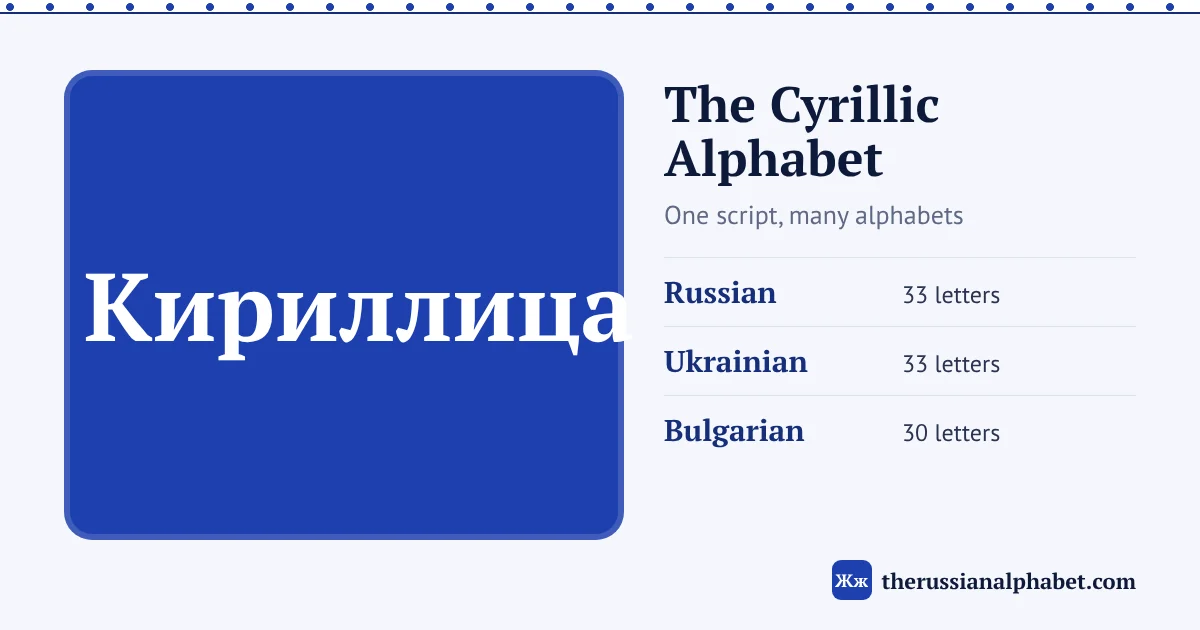
Cyrillic is a script, not a single alphabet. Each language that uses it has its own alphabet: Russian has 33 letters, Serbian 30, Kazakh 42. The script grew out of Greek capital letters plus new letters for Slavic sounds, created by disciples of Saints Cyril and Methodius in Bulgaria.
Script or alphabet?
People say “the Cyrillic alphabet” all the time, and that is fine in everyday speech. Strictly speaking, though, Cyrillic is a script: a shared set of letter shapes. Each language picks the letters it needs, adds a few of its own and fixes an alphabetical order. The result is a separate alphabet for each language.
Latin works the same way: Polish has ł and Turkish has ğ, yet both use the Latin script. Russian calls the script (kirillitsa, stress: ki-RIL-li-tsa). The everyday word for an alphabet is (alfavit, stress: al-fa-VIT), and a single letter is a (bukva, stress: BUK-va).
Where Cyrillic came from
The story starts with two brothers from Thessaloniki, Constantine (who took the monastic name Cyril) and Methodius. Around 862–863 the Byzantine emperor sent them as missionaries to Great Moravia, in today’s Czech Republic and Slovakia. For that mission they created the first Slavic alphabet, but it was not Cyrillic. It was Glagolitic, a script with unusual, looped letter shapes that look nothing like Greek.
Cyrillic came a generation later. After the mission in Moravia ended, disciples of the brothers found support in the First Bulgarian Empire. There, in the late 9th and early 10th centuries, scholars built a new alphabet from Greek capital letters and added letters for Slavic sounds that Greek could not show, several of them adapted from Glagolitic. Omniglot links its earliest form to the Preslav Literary School, and Britannica notes that Cyril’s disciples Clement and Naum are sometimes credited with devising it. The new script was named in Cyril’s honour.
A common myth says Saint Cyril invented the Cyrillic alphabet. The evidence points the other way: Cyril is linked to Glagolitic, and Cyrillic was developed after his death (he died in 869) by the circle of scholars who continued his work.
The old Slavonic word for the alphabet, (azbuka, stress: AZ-bu-ka), still means “ABC” or “primer” in Russian. It comes from the old names of the first two letters, az (А) and buki (Б), just as “alphabet” comes from Greek alpha and beta.
Russian Cyrillic changed twice in big ways. Peter the Great’s civil script reform of 1708 simplified letter shapes and dropped several old letters, giving the rounded print forms we know today. The spelling reform of 1918 then removed four more letters: і, ѣ (yat), ѳ (fita) and ѵ (izhitsa). That reform left Russian with the 33 letters it uses now.
Languages that use Cyrillic today
The best-known Cyrillic languages are Slavic, but the script also spread across Central Asia and Siberia during the Russian Empire and the Soviet period. Letter counts are for the standard modern alphabet.
| Language | Letters | Notes |
|---|---|---|
| Russian | 33 | Includes ё, ъ, ы, э |
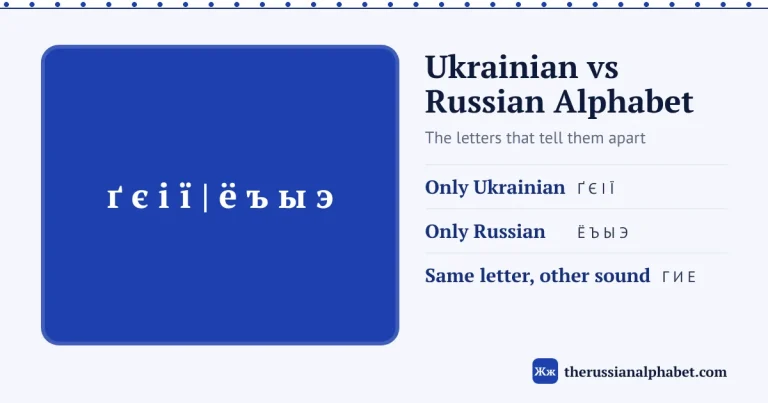
| Ukrainian | 33 | Has ґ, є, і, ї; no ё, ъ, ы, э |
| Belarusian | 32 | Has і and ў; no и, щ, ъ |
| Bulgarian | 30 | No ё, ы, э; ъ is a vowel, щ reads “sht” |
| Serbian | 30 | One letter per sound; Latin is also in official use |
| Macedonian | 31 | Close to Serbian, plus ѓ, ќ, ѕ |
| Kazakh | 42 | 33 shared with Russian plus 9 more; a move to Latin is planned |
| Kyrgyz | 36 | Russian letters plus ң, ө, ү |
| Mongolian | 35 | Russian letters plus ө, ү; in use since the 1940s |
Many more languages are written in Cyrillic, including Tatar, Bashkir, Chechen, Chuvash and Yakut inside Russia, and Tajik in Tajikistan.
Kazakhstan and the Latin script. Kazakhstan has announced a gradual switch from Cyrillic to a Latin-based alphabet. In 2021 a revised 31-letter Latin alphabet was presented, with a phased transition planned for 2023–2031, as reported by The Astana Times. The deadline has moved before (it was first 2025), so treat 2031 as a target rather than a fixed date. For now Cyrillic is still in everyday use.
How Russian fits in
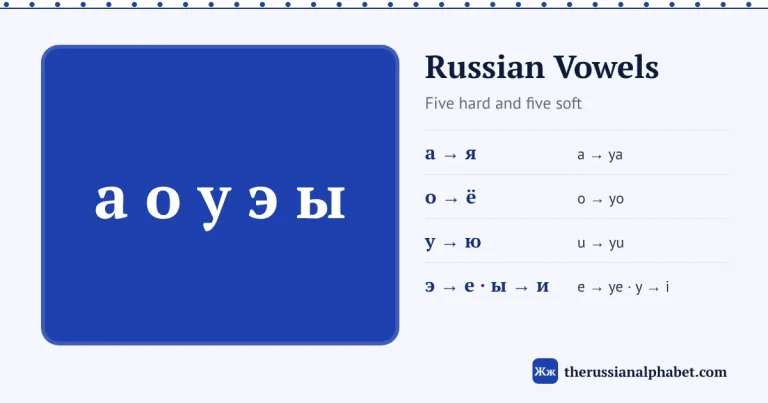
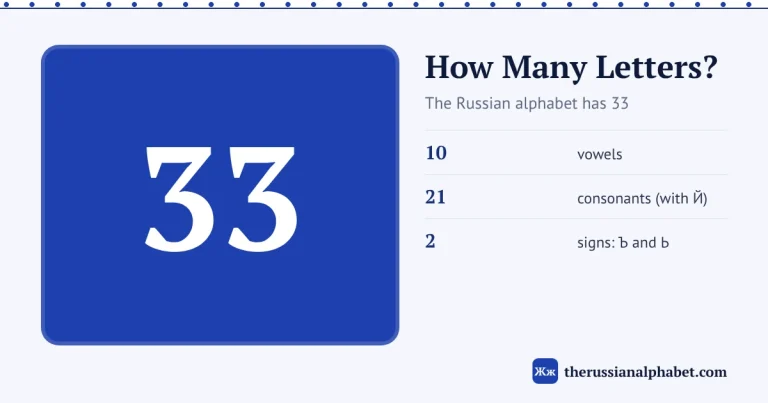
The Russian alphabet is one alphabet written in the Cyrillic script, and it is the one most learners meet first. It has 33 letters: 10 vowels, 21 consonants and 2 signs, ъ and ь, that have no sound of their own (more on that in how many letters are in the Russian alphabet). You can hear every letter on our interactive Russian alphabet chart.
If you can read Russian, you can sound out most other Slavic Cyrillic text, but some letters change their value. A few examples:
- Г is a hard “g” in Russian, but an “h”-like sound in Ukrainian and Belarusian.
- Щ is a long, soft “sh” in Russian (, shchi, cabbage soup), “shch” in Ukrainian and “sht” in Bulgarian.
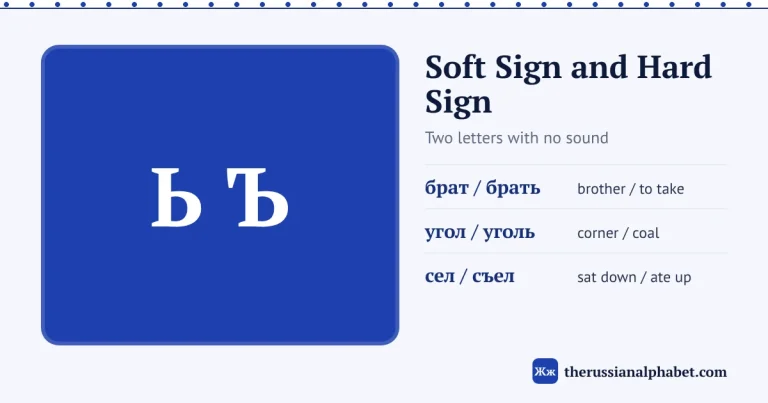
- Ъ is a silent separator in Russian (, pod”yezd, building entrance) but a full vowel in Bulgarian. See the soft sign and hard sign.
- И sounds like “ee” in Russian, but Ukrainian uses і for that sound and keeps и for a shorter vowel.
The Ukrainian case trips up the most readers, so it has its own page: Ukrainian vs Russian alphabet.
Letters you won’t find in Russian
These are the extra letters that most often puzzle Russian readers. Sounds are rough English guides, not exact phonetics.
| Letter | Used in | Approximate sound |
|---|---|---|
| І і | Ukrainian, Belarusian, Kazakh | “ee” in Ukrainian and Belarusian; a short i-type vowel in Kazakh |
| Ї ї | Ukrainian | “yee” |
| Є є | Ukrainian | “ye” as in yes |
| Ґ ґ | Ukrainian | hard g as in go |
| Ў ў | Belarusian | a short “w”-like u, as in cow |
| Ђ ђ | Serbian | soft “dj” |
| Ј ј | Serbian, Macedonian | y as in yes |
| Љ љ | Serbian, Macedonian | “ly”, close to the lli in million |
| Њ њ | Serbian, Macedonian | “ny” as in canyon |
| Ћ ћ | Serbian | soft “ch” |
| Џ џ | Serbian, Macedonian | j as in jam |
| Ѓ ѓ | Macedonian | soft “gy” |
| Ќ ќ | Macedonian | soft “ky” |
| Ѕ ѕ | Macedonian | “dz” |
| Ә ә | Kazakh | a as in cat |
| Ғ ғ | Kazakh | a voiced, throaty “gh” |
| Қ қ | Kazakh | a k said further back in the throat |
| Ң ң | Kazakh, Kyrgyz | ng as in sing |
| Ө ө | Kazakh, Kyrgyz, Mongolian | close to German ö |
| Ұ ұ | Kazakh | u as in put |
| Ү ү | Kazakh, Kyrgyz, Mongolian | close to German ü |
| Һ һ | Kazakh | h as in hat |
Cyrillic in Unicode
Computers store Cyrillic in its own Unicode blocks, separate from Latin. The main Cyrillic block runs from U+0400 to U+04FF and holds 256 characters. It has been part of Unicode since version 1.0 in 1991.
- The basic Russian letters А to я sit in one run, U+0410 to U+044F.
- Ё (U+0401) and ё (U+0451) sit outside that run, which is why some older software sorts ё in odd places.
- Letters for other languages fill the rest of the block, for example Ukrainian ї (U+0457) and Kazakh ә (U+04D9).
- Rarer and historical letters live in the Cyrillic Supplement (U+0500–U+052F) and Cyrillic Extended-A, B, C and D blocks.
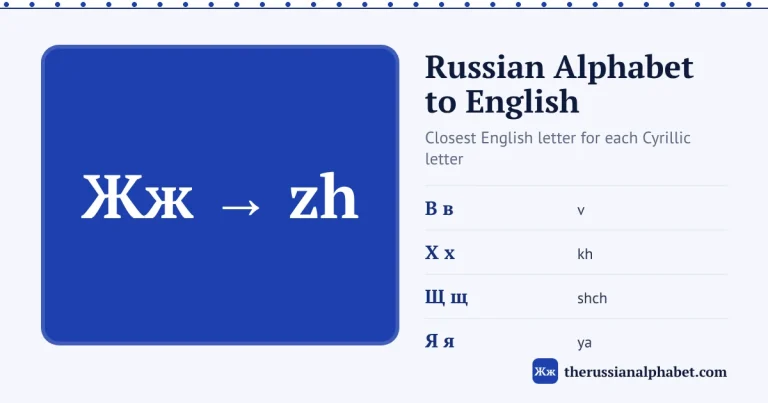
One practical point: Cyrillic А, О, Р and С look exactly like Latin A, O, P and C but are different characters. A word typed with a mix of the two can fail a search or a spell check even though it looks right on screen. To type genuine Cyrillic, use our online Russian keyboard; to turn Cyrillic into Latin letters, use the Russian transliteration tool.
FAQ
Is Cyrillic the same as the Russian alphabet?
No. Cyrillic is the script; the Russian alphabet is one of many alphabets written in it. Ukrainian, Serbian and Kazakh are also Cyrillic, but each has letters that Russian does not use.
Who invented the Cyrillic alphabet?
No single inventor is known. It was developed in the late 9th and early 10th centuries in the First Bulgarian Empire by disciples of Saints Cyril and Methodius, and named after Cyril. Cyril himself is linked to the earlier Glagolitic script.
How many letters are in the Cyrillic alphabet?
It depends on the language. Russian and Ukrainian have 33 letters each, Belarusian 32, Macedonian 31, Bulgarian and Serbian 30, and Kazakh 42.
Is Cyrillic based on Greek?
Largely, yes. Most Cyrillic letters come from Greek capital letters of the 9th century. Letters for Slavic sounds that Greek lacked, such as Ж, Ш and Ч, were added, several of them adapted from Glagolitic.
Which countries use the Cyrillic alphabet?
Russia, Ukraine, Belarus, Bulgaria, Serbia, North Macedonia, Kazakhstan, Kyrgyzstan, Mongolia and Tajikistan all use Cyrillic for their national languages. Serbia also uses Latin, and Kazakhstan plans a move to Latin.